The CNRS Particle Physics Laboratory in Annecy
LAPP is a joint research and higher education laboratory of the National Institute for Nuclear and Particle Physics (IN2P3), a CNRS institute which coordinates research programmes in these fields in France, and the University Savoie Mont-Blanc (USMB). Nearly 160 researchers, engineers, technicians, administrative staff and students work at LAPP.
Establishing a particle physics laboratory in Annecy in 1976 was a bold but successful challenge. Over the past forty-five years we have contributed to some of the most striking global achievements in particle and astroparticle physics, rewarded with the Nobel Prize in Physics (discovery of Z/W bosons, Higgs boson, gravitational waves…).

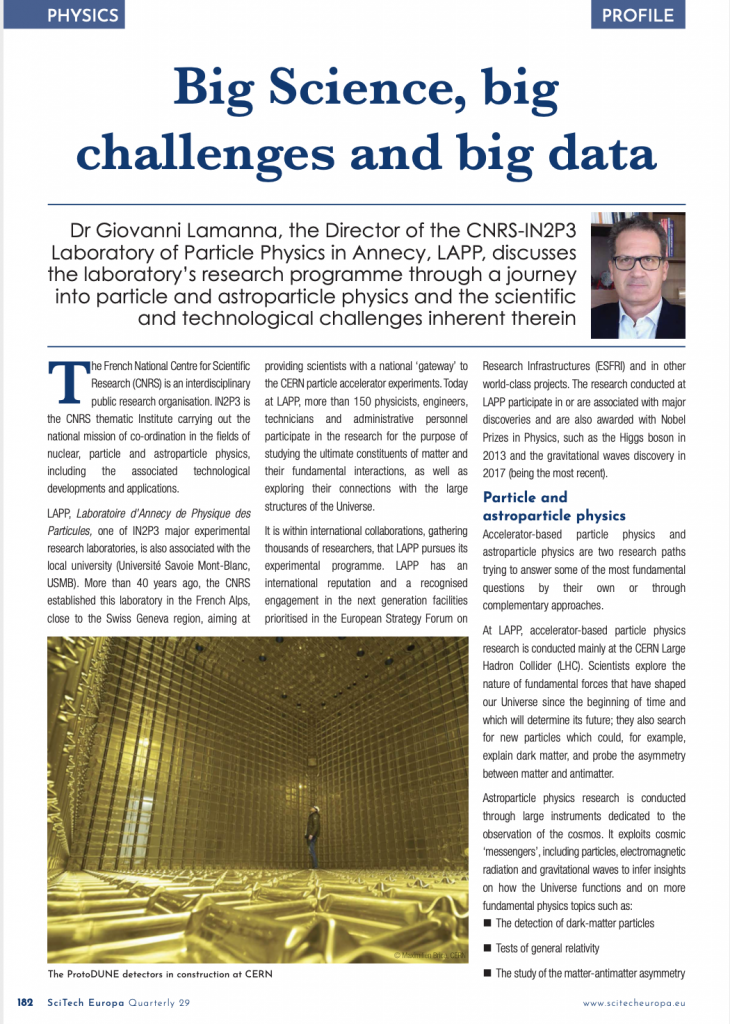
The research carried out at LAPP aims to study the physics of elementary particles and their fundamental interactions, as well as to explore their links with the great structures of the Universe. The work of the LAPP teams aims, among other things, to understand the origin of the mass of particles, to unravel the mystery of dark matter or to determine what happened to the anti-matter present in our universe at the time of the Big Bang. LAPP is a leading international laboratory in these disciplines, which require very large-scale transnational facilities. The laboratory’s research also makes a major contribution to the development of related technologies and applications.
It is within international collaborations, involving hundreds or even thousands of researchers, that LAPP teams pursue experimental programmes at CERN’s large accelerators or large instruments dedicated to the observation of signals from the cosmos.
The LAPP promotes its know-how through interdisciplinary actions within the University, through collaboration agreements with the industries and also in large-scale projects funded by the European Commission.
A flier..
My project for LAPP: a research center on fundamental physics (particle and universe), innovation, engineering, computer science and societal engagement.
LAPP benefits from the strategic proximity of CERN in Geneva, Switzerland.
LAPP collaborates with the theoretical physics laboratory (LAPTh) located on the same premises and also with other regional laboratories such as the LSM in Modane, LPSC and IPAG in Grenoble. As a result of these collaborations, LAPP has been coordinating the ENIGMASS « laboratory of excellence » project since 2012, which recently became a « research federation ».
Director of LAPP, first term (2015-2020)
Highlights:
- the first detections of gravitational waves by the Virgo project (with the very first discovery awarded by the Nobel Prize in Physics in 2017) and its detector upgrade phases.
- High commitment in the LHC science at CERN: with ATLAS about the direct searches for New Physics, detailed characterisation of the Higgs boson and exploration of the electroweak sector of the Standard Model; with LHCb about the radiative disintegration with photon channels and algorithm developments for neutral particles identification in the trigger.
- Relevant support and responsibilities for a long-term commitment in ATLAS for the upgrade of the on-line acquisition and the construction of the LAr calorimeter and ITK pixel detectors for both phases LHC Run 3 and HL-LHC.
- Responsibility for the LHCb Phase 1 upgrade with the implementation of an innovative software engineering architecture with a continuous integration tool for the development of the various acquisition board firmware (this involves programming 40 MHz PCIe40 reader boards for all the sub-detectors). CERN CLIC and FCC (post-LHC) R&D accelerator programme.
- An observational cosmology programme with the (LSST) Vera C. Rubin Observatory.
- Main milestone achieved in gamma-ray astrophysics with the construction and deployment of the first CTA telescope (LST-1), while producing science results with its precursor H.E.S.S.
- Intense neutrino research with the deployment of the detector for the underground SuperNEMO demonstrator, the mechatronic calibration systems of both STEREO at nuclear plant ILL and Proto-DUNE at CERN and their scientific exploitation, the start-up of the vertical drift detector programme for the long-baseline DUNE project.
- A structured policy, outreach and societal engagement programme producing important outcomes such as the EUTOPIA exhibition, some industrial cooperation, the award of the “CNRS platform” label to the LAPP-USMB-MUST data centre in support of regional SMEs and multidisciplinary studies.
- A relevant and successful leading commitment in open-science and open-data EU research programmes. Successfully explorative projects laying to sustainable interdisciplinary research between physics and data/computer science.
- The award of the government Labex Enigmass+ national research grant in partnership with the LAPTh and LPSC regional laboratories.
- Leading the FCC local project: particle accelerator optics and related technologies; machine-detector interfaces simulations and beam-stabilisation infrastructure R&D; innovation policy, economics and societal impact studies, outreach (2018-2025).
HCERES evaluation in 2019
In December 2019 the laboratory has been evaluated by an international committee of experts appointed by the HCERES (High Council for Evaluation of Research and Higher Education).
HCERES core values are independence, transparency and fairness commit to evaluate research institutions and universities every five years.
The experts have considered the LAPP achievements in the last five years during my directorate mandate as well as the scientific vision and project for the next five-year contract 2021-2025.
I am glad of a very laudatory evaluation perfomed by the HCERES experts for my personal important commitment in managing a fantastic laboratory such as LAPP as well as for all our colleagues and laboratory personnel deserving it. A concise version of the summary of the evaluation report is publicly accessible.
Some highlights:
LAPP “.. has preserved and increased during the evaluated period its high-level research programme … ». LAPP « scientists participate in these experimental activities in a well-balanced and comprehensive way, with contributions to hardware, software and analysis, so that the overall impact of the unit as a whole is known and recognized in each of the experiments in which they participate.”
“The remarkable technical excellence, one of its identity hallmarks, gives them a sound basis to make first-rank contributions to the construction of the experiments in which they participate and ensure a privileged position to take full advantage of the data. »
The scientific production « … is outstanding and the number of scientific talks, which give visibility and single out the unit’s contributions, is remarkable. Several other indicators, such as awarded grants, project funding, positions of responsibility and prizes, show a high-level profile of the research unit… commitment to outreach and public awareness towards science has increased both in quantity and quality. In this sense, their EUTOPIA project (”a space for discovery”) has been an excellent initiative. »
« The unit’s strategy for the coming five years is well structured and coherent. »
« In summary, the committee’s appraisal is that this is an excellent unit, with a broad and balanced research programme with several outstanding contributions, which significantly contributes to the training of young researchers and which has a well-defined and solid strategy for the future. »
Director of LAPP , second term of five years (2021-2025)
Highlights (2021-2023):
- the Virgo interferometer upgrade, construction, preparation and exploitation for the observation runs O2, O3 and O4 (currently under commissioning). Start-up of Einstein Telescope preparatory phase activities on a series of subjects: vacuum tubes, acquisition systems, optical noise control and reduction.
- The very first scientific exploitation of CTA LST-1 and the preparation for the construction of LST-2-to-4 as well as the first MST NectarCam.
- The consolidation of the Vera Rubin (LSST) research team committing in the camera commissioning and preparing the data challenges.
- The formal integration of IN2P3 in the DUNE project by relevant commitments in the construction of the CRPs of the vertical drift far detector and the analysis of the prototypes deployed at CERN.
- Publication of the final STEREO results and progresses in the joint analyses with Daya Bay and PROSPECT.
- Completion of important milestones in the detector upgrading for HL-LHC (such as pre-production of LAr calorimeter calibration ASIC and acquisition LATOURNET boards, qualification of the local integration site for ITK pixel detector, start-up of the type 0 on-detector services production) and exploitation of LHC Run3 (with the outstanding production and operation of the firmware and online software for the LATOME LAr boards) for ATLAS.
- Early measurements programme of Run 3, including the ECAL operations for LHCb and completion of the international coordination for the developments of the DAQ firmware.
- Among other achievements it is worth to remind 1 ERC consolidator, 2 Chairs of Professor Junior awards, the establishment of the Labex Enigmass Research Federation of the Alpine Furrow (from Geneva to Grenoble), a series of ANR projects and relevant EU INFRA grants.
- I leveraged the EU programmes to regional and local projects within the University (e.g. PIA4 Shine, two more pilots within IDEFICS) that have been successfully evaluated, funded and currently in progress.
- Conception of a new clean room and the test bench for R&D and training-by-doing activities for the Virgo upgrade as well as the ET preparation at LAPP.
- Committing regional resources for the implication of LAPP-FCC (Future Circular Collider) team in the CERN programme. Starting the FCC detector and physics studies.
IN2P3 50 years
On Tuesday 15 June 2021, the LAPP organised a celebration to mark the 50th anniversary of the Institut national de physique nucléaire et de physique des particules (IN2P3). An opportunity to look back on 45 years of common history!
You can find the video of the presentations on the LAPP Youtube channel
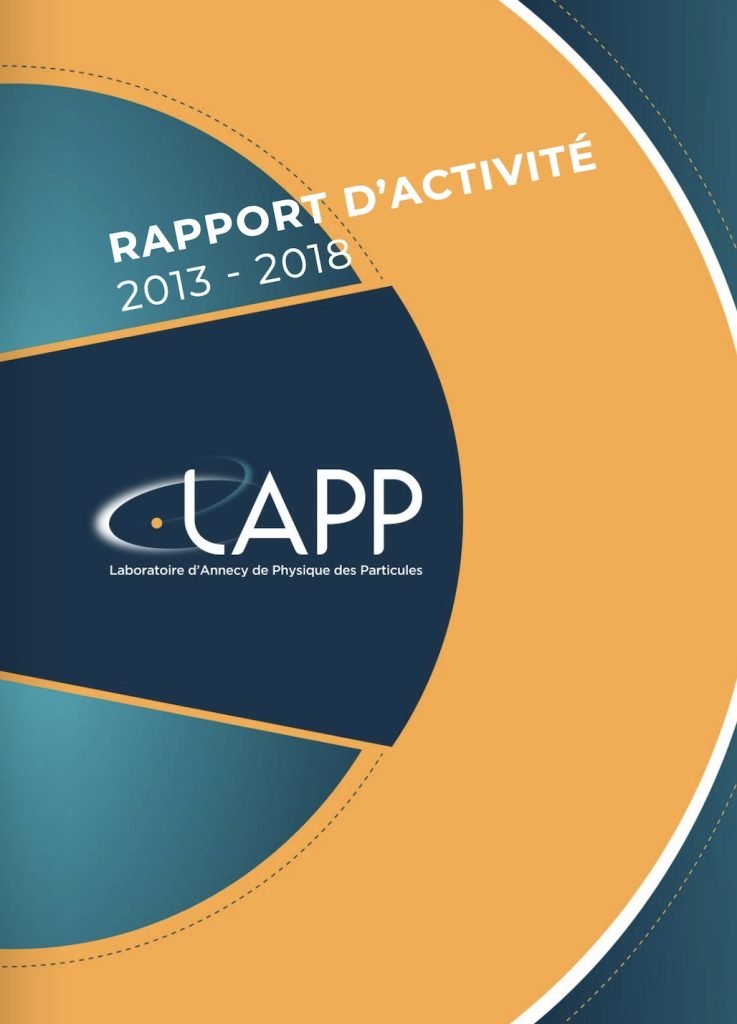
The 2013-2018 activity report:
The 2019-2023 activity report: